Industry Statistics and Trends
Market size and recent performance (2015-2030)
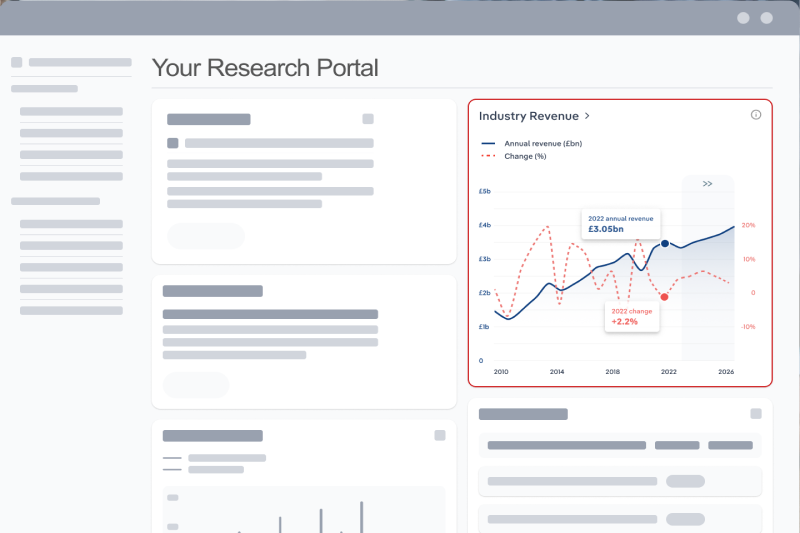
Industry revenue has declined at a CAGR of 0.7 % over the past five years, to reach an estimated £5.3bn in 2025.
Trends and Insights
Poor manufacturing activity drives a downturn in revenue
- Primary form plastics producers depend on strong manufacturing activity in subsectors like electronics, packaging, automotive and medical equipment. Plastics are used for various applications like electrical insulation, durable and chemical-resistant packaging and sterile surfaces for medical devices. When factory output slows, it directly reduces orders and sales for primary plastics manufacturers.
- Additional trends and insights available with purchase
Industry outlook (2025-2030)
Market size is projected to grow over the next five years.
Trends and Insights
High energy and feedstock costs make recycled materials more attractive
- As feedstock and energy costs keep rising, recycled plastics are becoming much more attractive in cost. Feedstock procurement is the highest cost for UK chemical producers, with oil-derived ethylene making up as much as three-quarters of polyethene manufacturing expenses, according to Ullmann’s Encyclopedia of Industrial Chemistry. When UK oil prices surged by 44% between January and June 2022, according to Trading Economics, both feedstock and energy costs hiked significantly, squeezing profit unless higher prices can be passed on.
Biggest companies in the Primary Form Plastics Manufacturing in the UK
| Company | Market Share (%)
2026 | Revenue (£m)
2026 |
|---|---|---|
INEOS Group Holdings SA | 325.0 | |
Advanced Elastomer Systems Ltd | 123.3 | |
SABIC UK Petrochemicals Ltd | 52.6 |
To view the market share and analysis for all 4 top companies in this industry, view purchase options.
Products & Services Segmentation
Industry revenue is measured across several distinct product and services lines, including Vinyl polymers, Acrylic polymers and Polyethers. Vinyl polymers is the largest segment of the Primary Form Plastics Manufacturing in the UK.
Trends and Insights
Polyethers benefit from downstream manufacturing activity
- Polyethers comprise an unusually diverse group of polymers, including any organic substance polymerised by establishing ether links between its molecules. Polyethers include all epoxide resins and polyacetal polymers.
- More insights available in the full report
Table of Contents
About this industry
Industry definition
This industry includes companies involved in the manufacture of resins, plastic materials and non-vulcanisable thermoplastic elastomers. It also includes companies involved in the mixing and blending of resins on a custom basis and in the manufacture of non-customised synthetic resins. The industry also includes the manufacture of cellulose and its chemical derivatives.
What's included in this industry?
Products and services covered in the Primary Form Plastics Manufacturing industry in the United Kingdom include Polyvinyl chloride and polyvinyl acetate, Acrylic polymers, Polyethers, Silicones, Polypropylene and Polyethylene.Companies
Companies covered in the Primary Form Plastics Manufacturing industry in the United Kingdom include INEOS Group Holdings SA, Advanced Elastomer Systems Ltd and SABIC UK Petrochemicals Ltd.Purchase this report to view all 4 major companies in this industry.
Related Terms
Related terms covered in the Primary Form Plastics Manufacturing industry in the United Kingdom include synthetic resins, dimensional tolerance, thermoplastic, polymer, bioplastic, polyvinyl chloride, polyethylene and polypropylene.Industry Code
SIC 20.16 - Primary Form Plastics Manufacturing in the UK
Performance
Get an indication of the industry's health through historical, current and forward-looking trends in the performance indicators that make or break businesses.
Analyst insights
Manufacturing slowdown dampens plastic demand. Weaker factory output and high costs have reduced plastics sales, prompting producers to prioritise efficiency and target more ...
In this chapter (4)
- Current Performance
- Outlook
- Volatility
- Life Cycle
Key metrics
- Annual Revenue, Recent Growth, Forecast, Revenue Volatility
- Number of Employees, Recent Growth, Forecast, Employees per Business, Revenue per Employee
- Number of Businesses, Recent Growth, Forecast, Employees per Business, Revenue per Business
- Total Profit, Profit Margin, Profit per Business
Charts
- Revenue, including historical (2015-2024) and forecast (2025-2030)
- Employees, including historical (2015-2024) and forecast (2025-2030)
- Businesses, including historical (2015-2024) and forecast (2025-2030)
- Profit, including historical (2015-2025)
- Industry Volatility vs. Revenue Growth
- Industry Life Cycle
Detailed analysis
- Trends in supply, demand and current events that are driving current industry performance
- Expected trends, economic factors and ongoing events that drive the industry's outlook
- Key success factors for businesses to overcome volatility
- How contribution to GDP, industry saturation, innovation, consolidation, and technology and systems influence the industry's life cycle phase.
Products and Markets
Learn about an industry's products and services, markets and trends in international trade.
Analyst insight
Environmental pressures hit packaging plastics. Purchases for primary plastics from packaging manufacturers are declining as regulators and consumers push for greener materia...
In this chapter
- Products & Services
- Major Markets
- International Trade
Key metrics
- Largest market segment and value in 2025
- Product innovation level
- Total imports, level and trend
- Total exports, level and trend
- Trade Balance
Charts
- Products & services segmentation in 2025
- Major market segmentation in 2025
- International trade, including imports by country and exports by country
Detailed analysis
- Trends impacting the recent performance of the industry's various segments
- Innovations in the industry's product or service offering, specialization or delivery method
- Key factors that successful businesses consider in their offerings
- Buying segments and key trends influencing demand for industry products and services
- Recent trends in import and export volumes, country of origin or destination, and expected future trends
Geographic Breakdown
Discover where business activity is most concentrated in an industry and the factors driving these trends to find opportunities and conduct regional benchmarking.
Analyst insights
Locating near major markets gives manufacturers a boost. In particular, primary form plastics manufacturers like to be close to construction industries – that’s why there are...
In this chapter (1)
- Business Locations
Charts
- Share of revenue, establishment, wages and employment in each region
- Share of population compared to establishments in each region in 2025
Tables
- Number and share of establishments in each region in 2025
- Number and share of revenue each region accounts for in 2025
- Number and share of wages each region accounts for in 2025
- Number and share of employees in each region in 2025
Detailed analysis
- Geographic spread of the industry across Europe, and trends associated with changes in the business landscape
- Key success factors for businesses to use location to their advantage
Competitive Forces
Get data and insights on what's driving competition in an industry and the challenges industry operators and new entrants may face, with analysis built around Porter's Five Forces framework.
Analyst insights
Buyers: product similarity keeps prices down. Buyers hold strong negotiating power as most plastics are easily comparable, lifting competition and limiting manufacturer margi...
In this chapter (4)
- Concentration
- Barriers to Entry
- Substitutes
- Buyer & Supplier Analysis
Key metrics
- Industry concentration level
- Industry competition level and trend
- Barriers to entry level and trend
- Substitutes level and trend
- Buyer power level and trend
- Supplier power level and trend
Charts
- Market share concentration among the top 4 suppliers from 2020-2025
- Supply chain including upstream supplying industries and downstream buying industries, flow chart
Detailed analysis
- Factors impacting the industry’s level of concentration, such as business distribution, new entrants, or merger and acquisition activity.
- Key success factors for businesses to manage the competitive environment of the industry.
- Challenges that potential industry entrants face such as legal, start-up costs, differentiation, labor/capital intensity and capital expenses.
- Key success factors for potential entrants to overcome barriers to entry.
- Competitive threats from potential substitutes for the industry’s own products and services.
- Key success factors for how successful businesses can compete with substitutes.
- Advantages that buyers have to keep favorable purchasing conditions.
- Advantages that suppliers have to maintain favorable selling conditions.
- Key success factors for how businesses can navigate buyer and supplier power.
Companies
Learn about the performance of the top companies in the industry.
Analyst insights
INEOS faces shrinking polymer sales and rising carbon costs. Weak purchases have lowered revenues and INEOS has prominently criticised mounting carbon taxes, warning of UK jo...
In this chapter
- Market Share Concentration
- Companies
- Company Spotlights
Charts
- Industry market share by company in 2021 through 2025
- Major companies in the industry, including market share, revenue, profit and profit margin in 2025
- Overview of INEOS Group Holdings SA's performance by revenue, market share and profit margin from 2019 through 2025
- Overview of Advanced Elastomer Systems Ltd's performance by revenue, market share and profit margin from 2019 through 2025
- Overview of SABIC UK Petrochemicals Ltd's performance by revenue, market share and profit margin from 2019 through 2025
- Overview of revenue, market share and profit margin trend for one additional company
Detailed analysis
- Description and key data for INEOS Group Holdings SA, and factors influencing its performance in the industry
- Description and key data for Advanced Elastomer Systems Ltd, and factors influencing its performance in the industry
- Description and key data for SABIC UK Petrochemicals Ltd, and factors influencing its performance in the industry
- Description, key data and performance trends for one additional company
External Environment
Understand the demographic, economic and regulatory factors that shape how businesses in an industry perform.
Analyst insights
Government energy support narrows cost gap with Europe. The British Industry Supercharger and upcoming BICS will lower power bills and improve competitiveness for plastics pr...
In this chapter
- External Drivers
- Regulation & Policy
- Assistance
Key metrics
- Regulation & policy level and trend
- Assistance level and trend
Charts
- Regulation & Policy historical data and forecast (2015-2030)
- Assistance historical data and forecast (2015-2030)
Detailed analysis
- Demographic and macroeconomic factors influencing the industry, including Regulation & Policy and Assistance
- Major types of regulations, regulatory bodies, industry standards or specific regulations impacting requirements for industry operators
- Key governmental and non-governmental groups or policies that may provide some relief for industry operators.
Financial Benchmarks
View average costs for industry operators and compare financial data against an industry's financial benchmarks over time.
Analyst insights
Oil price swings drive input costs and margins. Profitability for plastics manufacturers closely tracks crude oil movements, with recent volatility squeezing margins and keep...
In this chapter
- Cost Structure
- Financial Ratios
- Key Ratios
Key metrics
- Profit margin, and how it compares to the sector-wide margin
- Average wages, and how it compares to the sector-wide average wage
- Largest cost component as a percentage of revenue
- Industry average ratios for days' receivables, industry coverage and debt-to-net-worth ratio
Charts
- Average industry operating costs as a share of revenue, including purchases, wages, depreciation, utilities, rent, other costs and profit in 2025
- Average sector operating costs as a share of revenue, including purchases, wages, depreciation, utilities, rent, other costs and profit in 2025
- Investment vs. share of economy
Data tables
- Liquidity Ratios (2019-2023)
- Coverage Ratios (2019-2023)
- Leverage Ratios (2019-2023)
- Operating Ratios (2019-2023)
- Assets (2019-2023)
- Liabilities (2019-2023)
- Cash Flow & Debt Service Ratios (2015-2030)
- Revenue per Employee (2015-2030)
- Revenue per Enterprise (2015-2030)
- Employees per Establishment (2015-2030)
- Employees per Enterprise (2015-2030)
- Average Wage (2015-2030)
- Wages/Revenue (2015-2030)
- Establishments per Enterprise (2015-2030)
- IVA/Revenue (2015-2030)
- Imports/Demand (2015-2030)
- Exports/Revenue (2015-2030)
Detailed analysis
- Trends in the cost component for industry operators and their impact on industry costs and profitability
Key Statistics
Industry Data
Data Tables
Including values and annual change:
- Revenue (2015-2030)
- IVA (2015-2030)
- Establishments (2015-2030)
- Enterprises (2015-2030)
- Employment (2015-2030)
- Exports (2015-2030)
- Imports (2015-2030)
- Wages (2015-2030)
Top Questions Answered
Unlock comprehensive answers and precise data upon purchase. View purchase options.
What is the market size of the Primary Form Plastics Manufacturing industry in the United Kingdom in 2025?
The market size of the Primary Form Plastics Manufacturing industry in the United Kingdom is £5.3bn in 2025.
How many businesses are there in the Primary Form Plastics Manufacturing industry in the United Kingdom in 2025?
There are 374 businesses in the Primary Form Plastics Manufacturing industry in the United Kingdom, which has grown at a CAGR of 0.2 % between 2020 and 2025.
How may import tariffs affect the Primary Form Plastics Manufacturing industry in the United Kingdom?
The Primary Form Plastics Manufacturing industry in the United Kingdom is likely to be significantly impacted by import tariffs with imports accounting for a high share of industry revenue.
How may export tariffs affect the Primary Form Plastics Manufacturing industry in the United Kingdom?
The Primary Form Plastics Manufacturing industry in the United Kingdom is likely to be significantly impacted by export tariffs with exports accounting for a high share of industry revenue.
Has the Primary Form Plastics Manufacturing industry in the United Kingdom grown or declined over the past 5 years?
The market size of the Primary Form Plastics Manufacturing industry in the United Kingdom has been declining at a CAGR of 0.7 % between 2020 and 2025.
What is the forecast growth of the Primary Form Plastics Manufacturing industry in the United Kingdom over the next 5 years?
Over the next five years, the Primary Form Plastics Manufacturing industry in the United Kingdom is expected to grow.
What are the biggest companies in the Primary Form Plastics Manufacturing industry in the United Kingdom?
The biggest companies operating in the Primary Form Plastics Manufacturing industry in the United Kingdom are INEOS Group Holdings SA, Advanced Elastomer Systems Ltd and SABIC UK Petrochemicals Ltd
What does the Primary Form Plastics Manufacturing industry in the United Kingdom include?
Polyvinyl chloride and polyvinyl acetate and Acrylic polymers are part of the Primary Form Plastics Manufacturing industry in the United Kingdom.
Which companies have the highest market share in the Primary Form Plastics Manufacturing industry in the United Kingdom?
The company holding the most market share in the Primary Form Plastics Manufacturing industry in the United Kingdom is INEOS Group Holdings SA.
How competitive is the Primary Form Plastics Manufacturing industry in the United Kingdom?
The level of competition is moderate and increasing in the Primary Form Plastics Manufacturing industry in the United Kingdom.

Methodology
How are IBISWorld reports created?
IBISWorld has been a leading provider of trusted industry research for over 50 years to the most successful companies worldwide. With offices in Australia, the United States, the United Kingdom, Germany and China, we are proud to have local teams of analysts that conduct research, data analysis and forecasting to produce data-driven industry reports.
Our analysts start with official, verified and publicly available sources of data to build the most accurate picture of each industry. Analysts then leverage their expertise and knowledge of the local markets to synthesize trends into digestible content for IBISWorld readers. Finally, each report is reviewed by one of IBISWorld’s editors, who provide quality assurance to ensure accuracy and readability.
IBISWorld relies on human-verified data and human-written analysis to compile each standard industry report. We do not use generative AI tools to write insights, although members can choose to leverage AI-based tools within the platform to generate additional analysis formats.
What data sources do IBISWorld analysts use?
Each industry report incorporates data and research from government databases, industry-specific sources, industry contacts, and our own proprietary database of statistics and analysis to provide balanced, independent and accurate insights.
Key data sources in the UK include:
- Office for National Statistics
- Office for Budget Responsibility
- Bank of England
Analysts also use industry specific sources to complement catch-all sources, although their perspective may focus on a particular organization or representative body, rather than a clear overview of all industry operations. However, when balanced against other perspectives, industry-specific sources provide insights into industry trends.
These sources include:
- Industry and trade associations
- Industry federations or regulators
- Major industry players annual or quarterly filings
Finally, IBISWorld’s global data scientists maintain a proprietary database of macroeconomic and demand drivers, which our analysts use to help inform industry data and trends. They also maintain a database of statistics and analysis on thousands of industries, which has been built over our more than 50-year history and offers comprehensive insights into long-term trends.
How does IBISWorld forecast its data?
IBISWorld’s analysts and data scientists use the sources above to create forecasts for our proprietary datasets and industry statistics. Depending on the dataset, they may use regression analysis, multivariate analysis, time-series analysis or exponential smoothing techniques to project future data for the industry or driver. Additionally, analysts will leverage their local knowledge of industry operating and regulatory conditions to impart their best judgment on the forecast model.
IBISWorld prides itself on being a trusted, independent source of data, with over 50 years of experience building and maintaining rich datasets and forecasting tools. We are proud to be the keystone source of industry information for thousands of companies across the world.
Learn more about our methodology and data sourcing on the Help Center.