

Key Takeaways
- Industry context is essential because benchmarking borrower performance against sector trends separates normal cycles from true distress.
- Early warning systems provide lenders with the time to act by using clear thresholds, automation, and qualitative checks before small issues become defaults.
- Proactive monitoring protects both capital and credibility by catching red flags early and preserving strong lender–client relationships.
If you’re in credit, underwriting, or portfolio management, your days are a constant juggle: balancing speed with thoroughness, answering management’s questions before they ask them, and keeping your portfolio clean while clients expect quick decisions.
But here’s the hard truth: the real cost of being late isn’t just a write-off on the books. It’s strained client relationships, lost credibility with your risk team, and the ripple effect of explaining to senior management why an account went bad without warning. By the time a problem surfaces in repayment data, you’ve already lost valuable room to maneuver.

The flip side? Spotting trouble early gives you options. You can restructure before the borrower defaults, negotiate tighter covenants, or reallocate your monitoring bandwidth where it matters most. Today, foresight is just as valuable as capital.
Why early detection matters
We don’t need to be reminded that the economic backdrop is anything but steady. Higher-for-longer interest rates are raising financing costs. Sector-specific volatility, from commercial real estate to manufacturing, means some industries are tightening margins while others enjoy windfalls. Add in shifting borrower profiles and you’ve got an environment where yesterday’s safe bet could be tomorrow’s credit headache.
For a portfolio manager, the implications are stark. A subtle trend at the industry level, like declining demand in a supply chain or rising input costs, can cascade into repayment stress across multiple borrowers before it shows up in the profit and loss statement. One sector wobble can ripple through your entire portfolio.

That’s why early red-flag detection isn’t just about protecting single accounts; it’s about safeguarding the structural health of your portfolio. Every early warning buys you time to act before problems turn into losses.
What counts as a red flag?
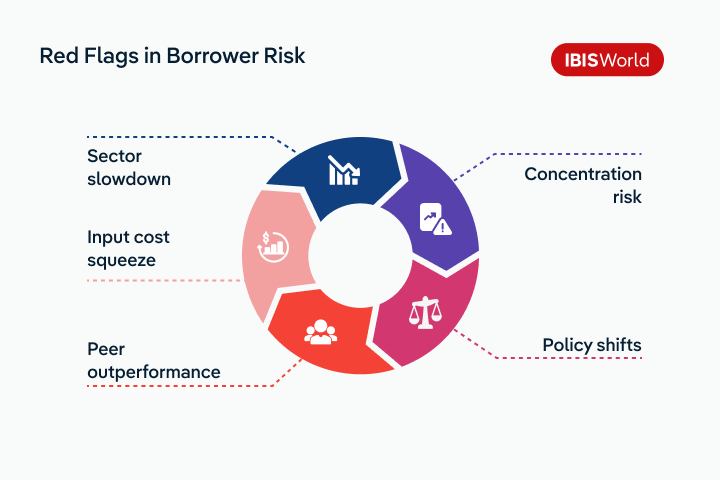
Red flags aren’t always flashing neon signs. More often, they start as quiet shifts in the data that get overlooked until they compound. The key is to differentiate between noise and genuine risk signals. Here’s where to look:
Industry-level signals
- Slowing sector growth and shrinking margins: Declining forecasts or revenue compression that outpaces inflation should trigger attention.
- Rising input costs without pricing power: If producers can’t pass along cost increases, watch for balance sheet strain.
- Insolvency upticks and distress-driven M&A: Competitors folding or consolidating under pressure are canaries in the coal mine.
Company-level signals (adjusted for industry norms)
- KPIs deteriorating faster than peers: Revenue declines or margin squeeze above the sector average point to borrower-specific weaknesses.
- Customer or supplier concentration: Heavy reliance on a single high-risk counterparty magnifies vulnerability.
- Chronic late reporting: Borrowers who repeatedly delay or provide incomplete financials may be masking operational stress.
Macro-environmental signals
- Regulatory and policy shifts: Compliance costs can balloon overnight in industries like healthcare, energy, or financial services.
- Commodity and currency volatility: Globally exposed borrowers are especially at risk when inputs or exchange rates swing beyond hedging coverage.
Each of these signals on its own may not spell disaster, but together, they form a pattern worth acting on.
Building an early-warning framework
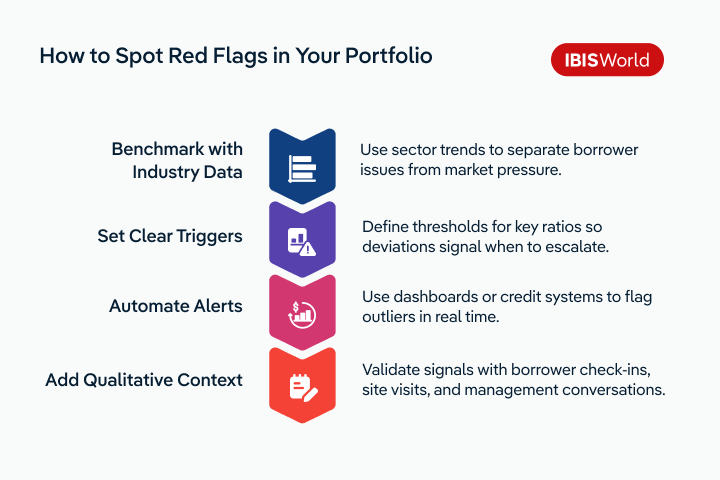
The real question here is: how do you systematize red-flag detection so you’re not relying on gut feel or anecdotal updates? Here’s a practical framework to build into your continuous oversight.
1. Use industry data as the baseline
Industry benchmarks are the guardrails that help you interpret borrower performance accurately. Looking at a borrower in isolation can mislead you. A temporary dip may look alarming, or real weakness might be brushed off as just the market. By grounding your monitoring in sector growth rates, margin medians, insolvency trends, and other industry-level indicators, you can quickly distinguish borrower-specific issues from broad market pressure. Industry data sets the normal range and makes deviations easier to spot before they escalate into real problems.
2. Define thresholds and triggers
An early warning system is only as strong as the lines you draw in advance. Thresholds give you objective markers for when to escalate. For example, if industry EBITDA margins typically average 12 percent, you might flag any borrower that falls 20 to 25 percent below that, especially if peers are holding steady. The same approach applies to leverage, liquidity, and coverage ratios. Set clear tolerances for deviation from industry norms. With predefined triggers, you shift monitoring from guesswork to evidence, and you will have a stronger case when communicating risk signals to credit committees or senior management.
3. Automate where possible
Markets move quickly and relying solely on manual tracking means you will always be a step behind. Automating alerts, whether through your credit systems, risk dashboards, or portfolio monitoring tools, creates a live feedback loop. The moment a borrower’s KPIs or sector indicators cross a preset threshold, you know where to focus. Automation does not replace judgment, but it ensures that you are not wasting resources monitoring accounts that are performing as expected. Instead, your team can focus attention where it matters most, the outliers.

4. Validate with qualitative intelligence
Numbers tell part of the story, but context fills in the gaps. A missed reporting deadline might reflect a genuine operational strain, or it might just be the result of an accounting software transition. That is why layering in qualitative intelligence is critical. Borrower check-ins, site visits, management conversations, and even informal market feedback help you validate what the data is signaling. Blending hard metrics with on the ground context reduces false alarms, strengthens borrower relationships, and helps you choose the right response, whether that is escalation, restructuring, or simply watchful waiting.
Turning red flags into lead time
Continuous oversight doesn’t mean staring at spreadsheets 24/7. It means building a framework that lets you anticipate, rather than react to, shifts in borrower risk. By combining industry data, clear thresholds, automated alerts, and relationship-driven insights, you gain the one thing that matters most: time.
Time to have the tough conversation with a borrower before covenants are breached. Time to restructure terms to preserve repayment ability. Time to redeploy capital and monitoring resources toward the exposures that need it most.

Spotting red flags before they hit your portfolio isn’t about perfection; it’s about increasing your odds of catching trouble while you still have levers to pull. In today’s volatile environment, that’s not just a best practice; it’s a survival strategy.
Risk insight: Don’t wait for the financial statements to tell the story. Watch the industry, set your thresholds, trust your alerts, and validate with conversations. The earlier you see the red flags, the stronger your portfolio and your reputation remains.
Case study: Catching trouble before it escalates
A regional bank was tracking a mid-sized manufacturer with overseas exposure. On the surface, the client looked stable: revenue was consistent, debt service current, and liquidity adequate. But sector-level signals told a different story. Rising raw material and freight costs were putting pressure on margins across the industry. Many competitors successfully passed on these costs, yet this borrower’s gross margin dropped well below the sector median.

An automated alert prompted a deeper dive. Discussions with management uncovered the root cause: heavy reliance on a small group of high-risk customers who refused price increases. That concentration left the company unable to defend profitability at a time when costs were climbing.
The bank acted early. It tightened financial covenants, secured additional collateral, and pressed management to broaden the customer base. Within a year, margins stabilized, concentration risk declined, and the borrower avoided breaching terms or sliding toward default.
Risk insight: Monitoring borrower performance against industry norms reveals hidden vulnerabilities and creates time to intervene. What looks fine in isolation can be dangerous once put in sector context.
Final Word
In a volatile market, the difference between a healthy portfolio and a costly surprise can include controllable elements. By anchoring borrower performance to industry benchmarks, setting clear thresholds, automating alerts, and validating signals through direct engagement, credit teams gain the foresight to act decisively. Early detection is not about eliminating all risk—it’s about creating options: restructuring before default, protecting capital before losses mount, and preserving credibility before questions arise. When red flags are spotted early, bankers aren’t just reacting to problems; they are actively shaping outcomes, strengthening client relationships, and safeguarding long-term portfolio health.