


Key Takeaways
- AI’s reliability is only as strong as the data beneath it: structured, verified, and contextual information turns automation into intelligence.
- Enterprises are moving from static research reports to living data systems, embedding trusted industry intelligence directly into copilots, RAG workflows, and decision tools.
- Even in an AI-driven world, human judgment remains essential, keeping insights credible, relevant, and grounded in reality.
IBISWorld is on the frontline in the war against AI slop – the flood of unverified, and often entirely fabricated, information generated by careless use of large language models (LLMs). AI is now writing reports, summarizing research, and advising decision-makers, yet it often does so with misplaced confidence. Studies show even the most advanced language models can “hallucinate” facts up to 79% of the time, depending on the task and dataset.
But AI itself isn’t the enemy. Its potential is huge, and it’s not going away. Every CEO and Board has an AI strategy now – whether they planned to or not.
The key is balance: harness AI’s power while keeping it anchored to credible, verifiable data. Because LLMs don’t create intelligence out of thin air – they inherit it from the data they’re trained on. Without structure, context, and verification, even the smartest models can wander from fact into fiction.
This foundation will fuel the next generation of AI systems: copilots, chatbots, knowledge assistants, and decision tools that rely on clarity and trust. When your data has structure, verification, and context, AI can finally do what it promises – deliver insight that’s reliable and real.
Watch the discussion below for a practical look at why structured, verified data matters and how it strengthens AI and integration workflows across the enterprise.
What is structured data and why does AI depend on it?
Structured data is what makes insight possible. It’s how both humans and AI connect the dots.
IBISWorld’s data isn’t just a pile of numbers – it’s a designed system. Every metric, from market size and profitability to industry risk and company market share, fits neatly into a consistent relational framework. That structure means our data can be used, compared, and connected without translation or guesswork.
Our database is built on hundreds of credible, traceable sources – from official government data to industry surveys. However, the raw source data we use is often messy: surveys are discontinued, schemas change, and definitions evolve. We do the hard work of reconciling those differences, so clients always get consistent, comparable information.
Over decades, we’ve refined this foundation into a unified global taxonomy – a shared language for understanding industries worldwide. Every dataset is relationally connected, linking inputs, drivers, risks, and outcomes – the same way they interact in the real economy. IBISWorld has built a living map of the global economy that makes our data easy for people to interpret and powerful for machines to use.
Every AI breakthrough depends on one thing: data that’s organized, consistent, and traceable. Structure is what lets machines reason instead of recite.
Data deep dive: How do you "structure" data?
Structured data means information that’s organized in a consistent, machine-readable format–where every variable, location, and industry code can be linked, compared, and verified across time.
For example, two key U.S. manufacturing sources–the Economic Census (every five years) and the Annual Survey of Manufactures (annual) – both report Annual Payroll (which IBISWorld calls Wages) for NAICS 33631 – Motor Vehicle Manufacturing, but their definitions, release cycles, and geographic boundaries differ.
Our data team ingests each source in its raw form (CSV, Excel, or API JSON), then normalize every value against reference tables for:
- Industry (NAICS → IBISWorld taxonomy)
- Location (FIPS geocodes)
- Variables (standardized definitions and units)
This process creates a single, structured dataset that can be queried in the same way across releases, years, and sources.
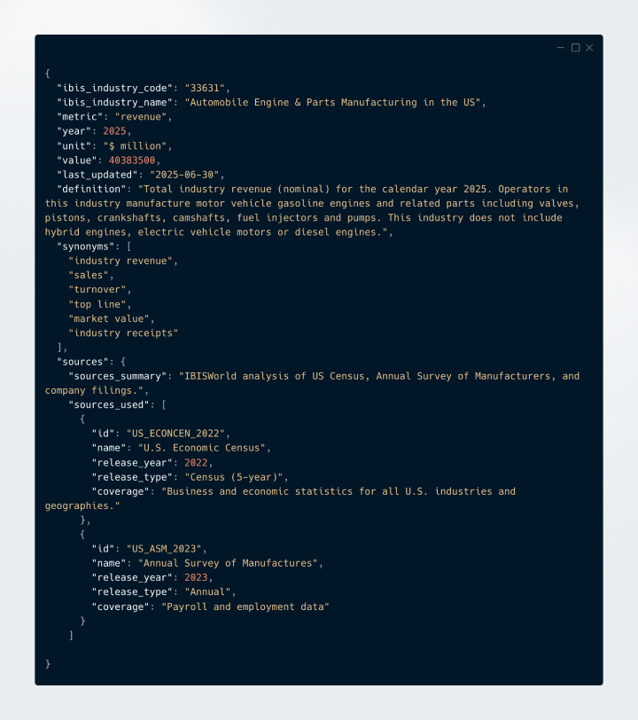
Every record in our database is linked, timestamped, and reproducible–meaning it can be rebuilt from source if needed. This structure is what allows our APIs, AI copilots, and research analysts to speak the same language when interpreting industry data.
Context turns data into understanding
IBISWorld’s vast dataset of numbers and facts is powerful–but it’s the context we add to those numbers that makes it truly valuable, especially as input for AI tools.
Every IBISWorld dataset is enriched with expert analysis that explains why things happen. Each year, our analysts write more than 30 million words that give industries shape, story, and connection.
This context is gold for text-based AI. Models can process data tables, but they don’t naturally understand them – especially when they span millions of rows. Context gives AI the ability to reason: to recognize that a drop in demand may be linked to regulation, or that risk scores tend to rise as capital intensity increases.
We use this same approach to improve our own AI tools — including Phil, our client-facing AI assistant that thousands of clients interact with every day on our website. We are currently experimenting with providing more context to every datapoint to make it easier for LLMs to read our data and provide high quality answers.
That’s why clients are embedding IBISWorld’s structured data and rich context directly into their copilots, RAG systems, and decision dashboards. Behind the scenes, we’re continually enriching our metadata and labelling to ensure that AI outputs powered by IBISWorld are consistent, explainable, and grounded in fact.
Data deep dive: How IBISWorld is adding context to our APIs for RAG
AI assistants are only as smart as the data they retrieve. When APIs return context-free numbers, large language models LLMs must guess what they mean-and that’s when hallucinations start.
To help, we’re re-engineering our APIs to make data self-describing. We are updating API responses to include not just the number, but the meaning, methodology, source, and other helpful metadata. This context makes AI-generated answers clearer, more consistent, and verifiable.
Before: A number without meaning
“Revenue: 40,383,500,000”
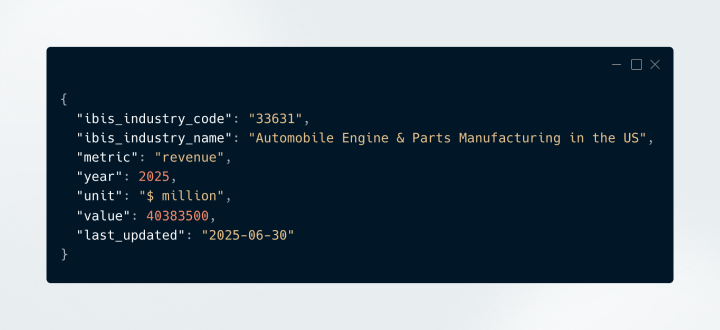
AI can read this, but it doesn’t know what kind of revenue this is — gross output or value added? Does it include EV motors or not? Without structure or description, models can’t give reliable explanations.
After: A number with context
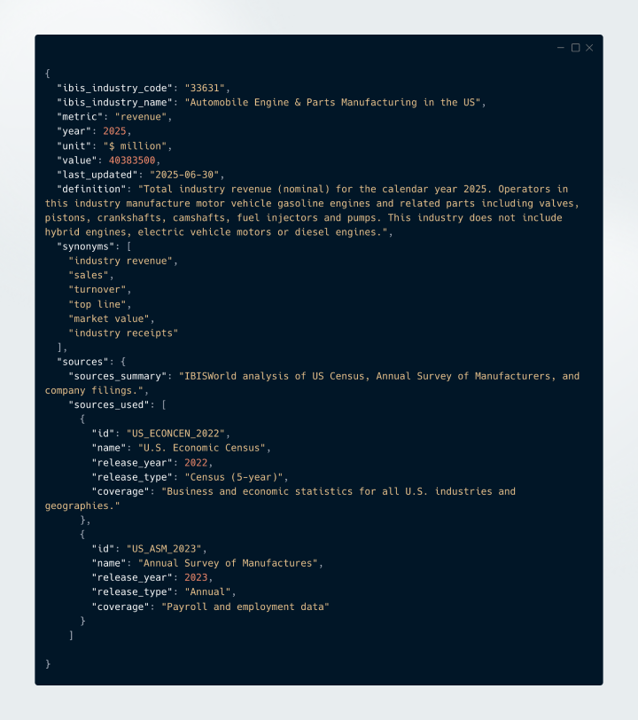
Now, an AI assistant or Copilot query like “How big is the U.S. auto engine and parts industry?” can respond accurately and explain its reasoning:
“In 2025, Automobile Engine & Parts Manufacturing in the US generated $40.4 billion in nominal industry revenue, based on IBISWorld analysis of the US Census and Annual Survey of Manufactures. The figure includes gasoline engines and parts, but excludes electric and diesel engines.”
Why Markdown matters
We’re also updating our API documentation to in Markdown. AI systems (like Copilot, ChatGPT, and RAG pipelines) read Markdown natively, which makes our content machine-friendly and human-readable. It helps models quickly locate definitions, identify schemas, and generate accurate responses in natural language.
AI needs a human compass
At IBISWorld, every one of our 30 million data points is built and reviewed by real people – more than 150 research analysts, editors, data engineers, software developers, and QA specialists. Our analysts and data engineers collect data from verified sources, test for outliers, and cross-check every result against history and logic. Our forecasting and imputation models – which make thousands of predictions across thousands of markets – are designed, maintained, and stress-tested by people, not just algorithms.
We know both the benefits and the limits of AI. Our analysts have been integrating AI tools into their research for more than three years – using AI to generate ideas, test assumptions, and review analysis. But there’s always a human in the loop. That oversight is what keeps our research credible.
In fact, AI has raised the bar for our editorial standards. Over the past two years we’ve focused on going deeper – not just describing what’s happening but explaining why it matters and what comes next. We use a “What–So What–Now What” framework to guide our analysis, pushing every insight beyond the obvious and ensuring our research delivers the depth and reasoning that AI alone can’t replicate.
IBISWorld’s analysis framework
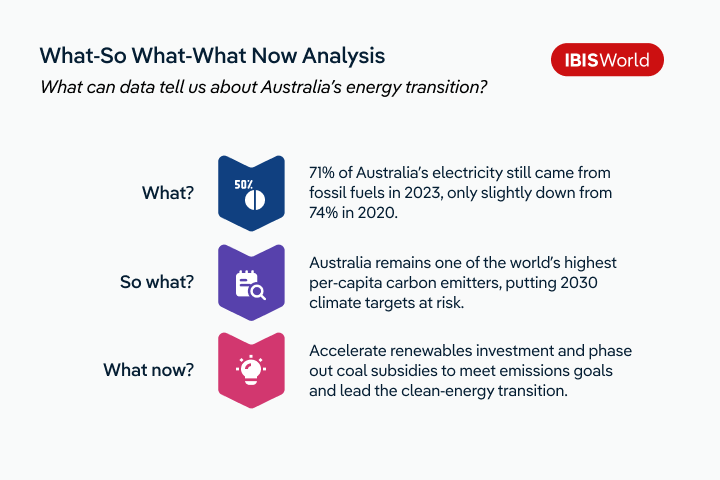
What? “According to Energy Australia, in 2023, 71% of Australia's electricity was still generated from fossil fuels, primarily coal and natural gas, representing a slight decrease from 74% in 2020”.
So what? “This continued reliance on fossil fuels means Australia remains one of the highest per capita carbon emitters among developed nations. The slow transition to renewable energy poses significant challenges for meeting the country's climate targets under the Paris Agreement, which aims for a substantial reduction in greenhouse gas emissions by 2030”.
Now what? “To accelerate the shift towards a sustainable energy future, the Australian government and private sector must increase investment in renewable energy infrastructure, such as wind, solar, and battery storage. Additionally, implementing policies like carbon pricing and phasing out coal subsidies will be crucial. These actions will not only help meet climate targets but also position Australia as a leader in the global renewable energy market”.
This human reasoning — connecting data to context and consequence — is what distinguishes our analysis from AI-generated summaries. Large language models can process data quickly, but they are not as adept at judgment, relevance, or nuance. That’s why we believe the future of industry intelligence isn’t AI or analysts - it’s both, working together. Automation is powerful, but it needs a human compass to stay on course.
Powering the next generation of AI
Across industries, organizations are re-engineering how they use data, embedding it directly into the systems where people think, decide, and act.
We’re already seeing how this transformation plays out in practice. Clients are embedding IBISWorld data directly into the tools that define modern enterprise AI.
- APIs and Knowledge Hubs: Organizations are shifting from manually downloading reports on IBISWorld’s portal to embedding our data directly into their own systems. Through our APIs, clients integrate industry intelligence into internal knowledge hubs, copilots, and RAG workflows that surface verified insights on demand. The result is not just speed - it’s accuracy and scale: analysts and client-facing teams can generate higher-quality outputs in less time, with the same trusted foundation of data.
- AI Assistants and Copilots: Others are embedding IBISWorld data into LLM applications so insights appear where people actually work – inside CRMs, dashboards, or productivity suites. Our upcoming connector with Microsoft Copilot, launching in early 2026, will take this even further.
- Analyst and Decision Tools: Some clients use IBISWorld data to train or ground their own internal AI tools – from credit risk models that need industry context, to sales intelligence platforms that generate tailored outreach.
It’s a shift from static PDFs to living intelligence – data that’s retrievable, explainable, and trusted. This is the direction modern AI, like Claude for Financial Services, is heading: structured, verified, and transparent data at the core, not as an afterthought. These systems rely on market-traceable structured data – information that’s consistently labelled and verifiable back to its original source - to deliver reliable, explainable answers at enterprise scale.