


Key Takeaways
- Affordability pressures and cost-of-living inflation are driving households to rely on debt more frequently. As essentials like housing, transportation and groceries outpace income growth, households increasingly use credit to bridge gaps, raising monthly obligations and financial strain.
- High-income consumers carry larger debt balances tied to wealth-building assets like homes and education. They’re better positioned to manage repayment due to stronger earnings and greater access to credit, making their debt less sensitive to economic shocks.
- Elevated interest rates are amplifying the cost of carrying debt across categories. Higher rates increase monthly payments on new and variable-rate borrowing, especially on credit cards and recent loans, which tightens budgets and limits discretionary spending.
- The composition of debt reveals growing financial fragility among lower-income households. Increased reliance on high-cost, unsecured credit to fund essentials exposes these borrowers to higher delinquency risk, especially given limited savings and volatile income.
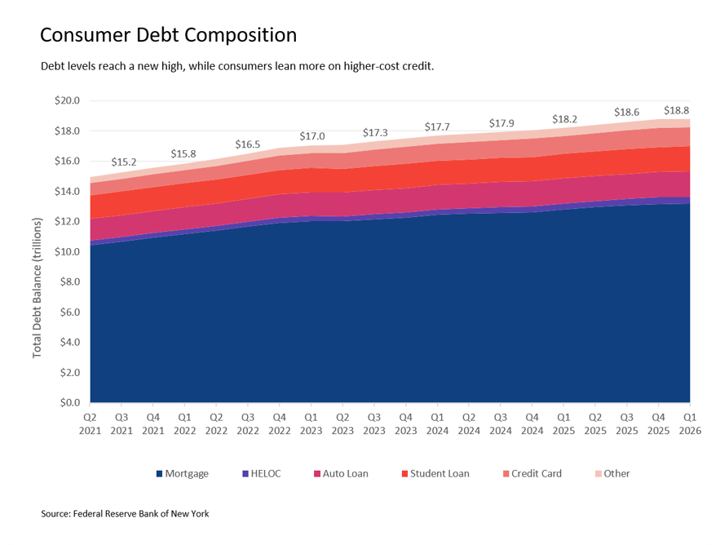
Consumer debt has become a larger fixture in household budgets as the costs of housing, transportation, education, healthcare and everyday essentials have climbed faster than income growth. According to the Federal Reserve Bank of New York (New York Fed), total household debt reached an all-time high of $18.80 trillion in the first quarter of 2026, including $13.64 trillion in housing-linked credit and $5.16 trillion in non-housing balances.
Elevated average debt bills reflect several forces working simultaneously: higher purchase prices expand loan sizes, elevated interest rates raise the cost of carrying balances and thinner savings accounts buffer a greater reliance on credit to smooth cashflow. The burden, however, is uneven. Higher-income households tend to hold larger balances tied to asset and wealth accumulation, such as mortgages and education, while lower-income households rely more often on high-cost credit to fund essential spending. Their debt is much more sensitive to income volatility and interest rates.
Housing and home equity
Housing is the largest component and primary driver of consumer debt. Mortgage balances reached $13.19 trillion at the end of March 2026, up from $11.50 trillion four years prior, per the New York Fed. Higher loan sizes per transaction are driving mortgage debt growth as home sales remain subdued. Elevated home prices and mortgage rates have lifted the amount borrowers must finance. With many existing homeowners locked into low fixed rates, interest rate sensitivity is concentrated among new buyers, reinforcing affordability constraints without triggering widespread deleveraging.
Home equity borrowing shows how higher asset values can also raise debt capacity. More than half of homeowners with mortgages have rates below 4.0%, which encourages them to stay put and renovate. Home equity lines of credit (HELOC) balances rose by $12.0 billion to $446.0 billion in the first quarter of 2026, marking the 16th consecutive quarterly increase. For homeowners, tapping equity can be a lower-cost way to fund renovations, consolidate credit card debt or cover large expenses such as tuition. Yet it also means households are adding to the monthly debt bill by borrowing against the value of their homes.
Higher-income homeowners disproportionately leverage debt alongside property ownership, as they typically benefit from strong credit profiles and asset appreciation. More vulnerable households typically have lower homeownership rates, which reduces their mortgage exposure but also limits their ability to accumulate equity that they can tap into as a relatively affordable source of liquidity.
Auto loans
The cost of buying and financing a vehicle has remained high after vehicle prices jumped significantly throughout 2021, pushing auto debt higher in turn. Car note balances reached $1.69 trillion in the first quarter of 2026, increasing by $18.0 billion. The pandemic supply crunch, followed by fiscal stimulus-driven demand, semiconductor shortages and tariffs on steel, aluminum and other auto parts, drove the consumer price index for new and used motor vehicles upward. Higher interest rates then turned those larger loan amounts into higher monthly payments, while longer loan terms helped keep payments manageable at the cost of more interest over time.
Auto debt growth is also structural, reflecting the essential nature of vehicle ownership in most US labor markets. Slower loan growth may reflect consumers trading down to used vehicles, but used cars are still expensive relative to pre-pandemic norms. For borrowers with minimal savings or weaker credit, the debt bill can compound quickly because the loan payment is only one part of the cost. Insurance, repairs and fuel costs all track with the loan, making transportation one of the clearest examples of debt tied to necessity rather than discretionary spending.
Student loans
Student debt is a significant component of many household budgets, but it is no longer a primary driver of overall debt growth. Loans stood at $1.66 trillion in Q1 2026 and have remained relatively flat in recent years, with a reduced role in driving aggregate debt growth even as repayment strain intensifies. Fewer new student loan accounts are being originated, indicating slower borrower growth, yet total origination volumes have still increased, reflecting higher borrowing among those who do take out loans.
The burden depends heavily on post-education outcomes, though. Borrowers with graduate or professional degrees often carry larger balances but benefit from stronger earnings; those who do not complete their degrees therefore enter lower-paying fields and face a greater risk of delinquency even with smaller loan amounts.
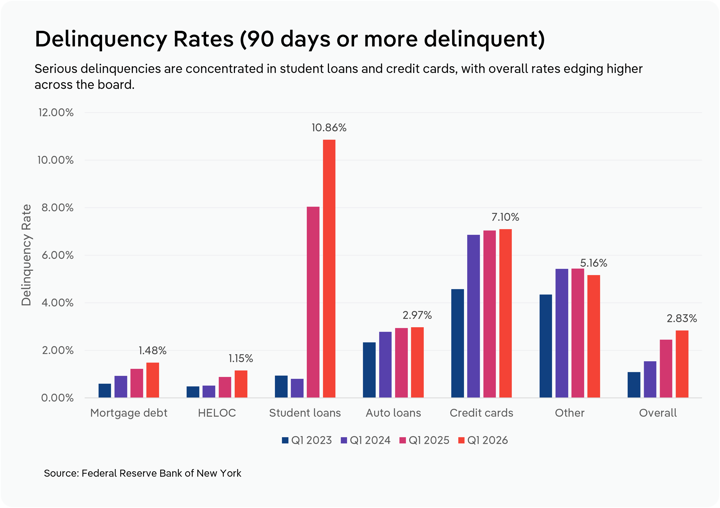
Repayment strain has become more visible, especially after the end of the pandemic-era student loan payment pause. In Q1 2026, the New York Fed measured 10.3% of student loan balances as 90 or more days delinquent, up from 9.6% in the prior quarter. The return of required payments and credit reporting has reintroduced monthly obligations into household budgets, particularly for borrowers whose income has not kept pace with inflation. As a result, the student loan market is now defined less by rapid balance growth and more by rising repayment pressure, which can constrain spending on essentials such as transportation, groceries and housing.
Credit cards and other revolving credit
Credit cards are where the higher cost of everyday life is showing up most directly. Card balances reached $1.25 trillion in the first quarter of 2026, even after falling by $25.0 billion during the quarter. Groceries, housing and utilities continue to shape household budgets following several years of strong inflation. According to YouGov, 66.0% of adults who make a budget said they do so to ensure they have enough money for essentials, such as food, rent and bills. When essential expenses rise faster than income, revolving credit becomes a short-term liquidity lifeline.
YouGov data shows that debt is more often used to cope rather than to progress. 22.0% of borrowers cited everyday essentials as the reason for their debt, and 21.0% cited unexpected expenses or emergencies. This cashflow bridge carries an expensive toll, as credit card interest rates adjust quickly with monetary policy and are among the highest in consumer finance. While cards can be a low-friction payment tool for households that pay balances in full, they become a high-cost form of borrowing for households that revolve balances month to month.
Equifax connects the record debt level to more subprime borrowers opening new bankcards and carrying higher balances, with bankcard balances up almost 4.0% year-over-year and subprime originations up 18.6%. For these borrowers, revolving balances are increasingly financing essentials. Balance sheet expansion, rather than real income growth, is supporting consumption, which is concentrating repayment risk where financial buffers are thinnest.
Other debt: Personal loans, medical debt and miscellaneous credit
The remaining debt categories are smaller in aggregate but often explain why monthly bills feel harder to manage. Personal loans have grown as banks, online lenders and fintech platforms make unsecured installment credit easier to access. Borrowers use them to consolidate higher-rate balances, cover emergencies, pay for repairs or finance large purchases, effectively turning short-term cashflow gaps into fixed monthly payments. For many households, those gaps can’t be covered by savings alone. Per YouGov, 22.0% of Americans have no cash savings, 14.0% have less than $1,000 and 12.0% have between $1,000 and $5,000 available. With such limited safety nets, even modest shocks are more likely to become personal loans or other unsecured balances.
Medical debt and other emergency borrowing are less about consumer choice than exposure to shocks. Insurance gaps, high deductibles and billing complexity can turn a health event into a financing problem, especially for households with limited savings cushions. When an unexpected medical bill, car repair or home repair arises, many households rely on personal loans or similar unsecured credit, adding another line item to already strained budgets. These “other” debts may not drive headline totals, but they disproportionately affect households with thinner liquidity reserves and more volatile incomes. As a result, they are a key source of perceived financial stress.
The broader implications
Historically, elevated household leverage tends to make downturns sharper and recoveries slower when shocks arrive. Leading up to the Great Recession, household mortgage debt climbed sharply from roughly 60.0% of GDP in the late 1990s to nearly 100.0% in 2006, according to the Federal Reserve. This enabled a period of strong consumption growth that was partly financed by borrowing against rising home values. When house prices reversed and credit standards tightened, highly leveraged households pulled back spending to repair their balance sheets, contributing to a deeper contraction and a long, uneven recovery, especially in regions with the largest housing busts.
The current cycle differs in important ways from the pre-2008 period: household debt relative to GDP is below its pre-crisis peak, mortgage underwriting standards are tighter and banks hold greater capital reserves, reducing the risk of household stress transmitting through the financial system. Yet some familiar fault lines are becoming visible. With consumer spending accounting for 67.9% of GDP in Q1 2026, a scenario in which more households are forced to redirect income from discretionary purchases toward debt service would change more than the mix of spending; it could make aggregate demand more sensitive to labor market softness or further credit tightening. In that environment, sectors that depend on optional purchases—such as discretionary retail, travel and other personal services—will likely feel that pressure first. At the same time, consumer lenders face the challenge of balancing growth in high-yield products against rising repayment risk, particularly in subprime and near-prime segments that have driven much of the recent expansion in revolving and unsecured credit.
Final Word
The record level of consumer debt is less about how much households owe and much more about how that debt is distributed and used. Borrowing tied to wealth accumulation, particularly housing and education, remains largely concentrated among higher-income households with relatively strong balance sheets. On the other hand, growth in high-cost revolving credit and unsecured borrowing is increasingly held by households using debt to manage recurring expenses, where sensitivity to interest rates and income disruptions is significantly higher.
As a result, the trajectory of consumer credit will play a central role in shaping economic outcomes. Rising delinquencies in lower-income segments, tighter lending standards or a softening labor market could quickly shift debt from a stabilizing force into a constraint on growth, with the most immediate effects felt in discretionary retail, consumer finance and other rate-sensitive sectors.