

Key Takeaways
- Credit teams are moving into a new era where AI elevates human judgment and shifts time toward deeper analysis.
- As AI adoption accelerates, banks are being pulled into financing an entirely new capital backbone built on data centers and energy infrastructure.
- Risk management is rapidly becoming proactive as AI uncovers early warning signals long before traditional processes ever could.
When I arrived in Chicago for this year’s International Association of Credit Portfolio Managers (IACPM) conference, I was prepared for deep discussions about AI, credit risk, and the future of portfolio management. What I wasn’t prepared for was the deep dish. As someone who normally believes pizza shouldn’t require a fork, I quickly learned two things:
- Chicago takes food as seriously as risk governance, and
- both can leave you feeling extremely full.
Humor aside, IACPM is one of the most important annual gatherings for credit portfolio managers, risk leaders, and financial institutions around the world. It’s where banks share emerging challenges, compare practices, and—this year more than ever—confront the transformative impact AI is having on credit processes, talent, and decision-making.
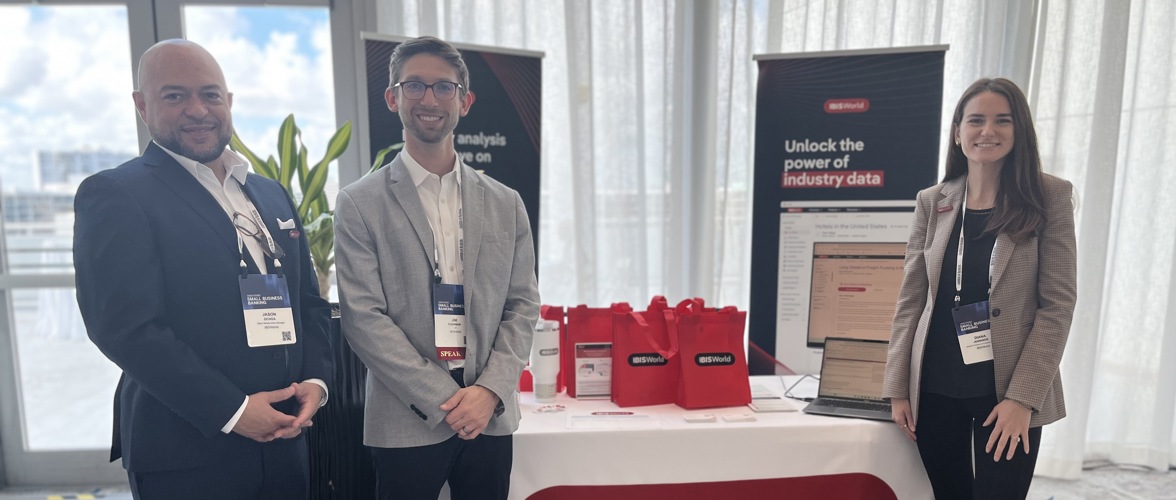
I attended on behalf of IBISWorld, with a clear purpose: to help banks understand how industry intelligence supports a proactive approach to credit portfolio management. Our goal is to empower credit teams with the foresight to identify emerging sector risks, concentration build-ups, and macro-industry stress signals before they translate into losses. And at this year’s conference, that message aligned perfectly with the broader industry shift toward AI-powered early detection and smarter credit monitoring.

After two days of sessions, side conversations, and more than one encounter with an overwhelming Italian beef sandwich, three themes stood out above all others—each pointing toward a radical evolution in credit portfolio culture.
1. AI isn’t replacing credit judgment—it’s elevating it
Across the conference, one message consistently cut through the noise: AI is not here to eliminate judgment but to multiply its impact.
Bill Ledger from JPMorgan set the tone early when he said, “Economies are becoming dependent on AI—but the question is whether the value of this investment is worth it.” His answer was practical: AI shouldn’t focus on replacing humans; it should “improve the basics,” like client selection and underwriting standards.
That sentiment echoed throughout the event.
Som-Lok of IACPM emphasized that regulators are beginning to appreciate AI’s ability to reduce error rates—an ironic twist considering their initial concerns about model risk and opacity. When AI is governed properly, it doesn’t create uncertainty; it reduces it.
This reshaped my thinking. AI is no longer being discussed as a futuristic overlay. It’s becoming the backbone of a modern credit portfolio culture—one where analysts are freed from data wrangling and empowered to focus on higher-order judgment, pattern recognition, and strategic conversations.

McKinsey & Company, who led one of the conference’s technical sessions, reinforced the point with data. They asked the room: “Can Agentic AI live up to high expectations?” Their answer was yes—when embedded in domain-specific workflows. In credit analysis, Agentic AI reaches 90–95% output quality, far above generic AI models.
As they put it:
- Traditional credit work = “1x” productivity
- GenAI assistance = “2x”
- Fully agentic, multi-step automation = “20x”
It became clear that AI isn’t simply speeding things up; it’s changing how credit professionals spend their time—shifting the culture from manual tasks to analytical depth.
2: AI has become a capital story—not just a technology story
If the first theme was about human capability, the second theme was about capital allocation—and how AI is reshaping what banks are financing.
Kyle Hutzler of JPMorgan delivered one of the most eye-opening insights of the conference: AI doesn’t just change how banks operate internally. It creates massive external demand for capital.
“AI itself is creating enormous capital needs,” he said, citing MUFG’s projection that AI-driven investment will triple by 2030.
Think about the chain reaction:
- AI → more data centers
- More data centers → more energy demand
- More energy demand → more infrastructure investment
- More infrastructure → more project finance and long-term credit exposure
In other words: AI is becoming one of the largest emerging drivers of credit demand.

That’s exactly where IBISWorld’s role became relevant. As banks race into AI-linked lending opportunities, understanding sector volatility, competitive dynamics, and industry lifecycle risks becomes non-negotiable. Credit teams need industry intelligence that identifies stress early, not reactively.
And this connects directly to the third theme.
3: AI is transforming risk management into a proactive discipline
One of the most poignant discussions of the conference centered on proactivity.
Elena Eyries of Banco Santander captured this perfectly when she said, “AI drives the power of efficiencies.” But she didn’t mean cost savings—she meant responsiveness. The ability to move from reactive to proactive portfolio management.
Kaikobad Kakalia from Chorus Capital added that AI helps uncover relationships in data “banks may have never been aware of.” That message resonated with me deeply. Credit risk has historically been backward-looking—anchored in quarterly filings, lagging indicators, and manual portfolio reviews.
- Pull real-time sentiment from the news.
- Nowcast revenue changes before earnings.
- Identify exposure clusters you didn’t know you had.
- Surface early warning signals long before traditional indicators.
McKinsey showed a compelling example: AI-powered Early Warning Systems can detect credit deterioration weeks or months ahead of traditional methods. And their multi-agent AI models hit 94% accuracy, compared with just 55% from standard LLMs.

The crowd reaction to that stat said everything. You could feel the room realizing that the old way—quarterly reviews, manual spreads, and intuition-driven signals—is incompatible with the speed of modern market volatility.
AI is becoming the new early warning culture.
And for IBISWorld, this is where we lean in. Industry shifts often emerge before company-level financial stress. Sector intelligence helps credit teams see the forest before inspecting the trees. Together, industry context + AI-driven alerts create a level of foresight that defines a truly proactive credit portfolio culture.
Final Word
By the time I left the conference, one realization stayed with me:
AI in credit isn’t a technology revolution—it’s a culture shift.
It is:
- Changing how analysts think
- Transforming how teams collaborate
- Guiding how banks allocate capital
- Rewriting how portfolio risk is identified
- And reshaping the expectations of regulators
AI isn’t replacing judgment; it’s amplifying it.
It isn’t eliminating credit professionals; it’s elevating them.
It isn’t reducing human skill; it’s redefining it.
I left the IACPM conference convinced that the future of credit portfolio management will be built on proactive intelligence, powered by a combination of:
- Industry foresight
- Agentic AI
- Human expertise
And yes—maybe a bit of Chicago deep dish to sustain the journey.