
IBISWorld Platform
Answer any industry question in minutes with our entire database at your fingertips.

IBISWorld expects the total number of domestic visitor nights to rise 1.4% in 2026-27 to 385.5 million. This follows two broadly flat years, with visitor nights edging up 0.3% in 2024-25 and slipping 0.1% in 2025-26. Tourism Research Australia's Domestic Tourism Statistics describe conditions as stable, with visitor nights across the year to March 2026 up around 1% on the prior year, despite overnight trips dropping 2%. The picture is one of resilient but subdued demand rather than the sharp post-pandemic rebound recorded earlier in the decade.Cost-of-living pressure is the dominant force shaping travel behaviour. Households have continued to travel, but many are managing budgets by taking shorter overnight trips, substituting day trips for overnight stays and choosing destinations closer to home. A YouGov survey conducted in April 2026 found that 59% of Australians had changed their 2026 travel plans, with 16% opting for closer or more affordable destinations and an additional 16% cutting their travel spending. Persistent price growth in accommodation and food service has reinforced this restraint, with Tourism Research Australia noting that the cost of travelling within Australia has risen faster than general inflation. At the same time, record outbound travel has diverted some discretionary demand from domestic trips, but a recent surge in international airfares and geopolitical tensions could draw people back to domestic travel in 2026-27.Domestic visitor nights remain concentrated in leisure travel. Holiday trips account for roughly 47% of visitor nights and visiting friends and relatives account for 37%, so around five in six nights are tied to discretionary or social travel that is sensitive to consumer sentiment and household budgets. Business travel accounts for close to 9% of nights, with the remainder split between education and other purposes.Regional Australia continues to capture the majority of domestic travel. Tourism Research Australia's March quarter 2026 data shows that regional destinations account for more trips than capital cities across every age group and the preference is strongest among older travellers. Those aged 65 and over took 69% of their trips outside capital cities. New South Wales remains the largest state market, accounting for around 32% of visitor nights, ahead of Queensland at roughly 24% and Victoria at about 23%. Because most Australians live in metropolitan areas, leisure and holiday travel tends to flow outward to regional and coastal destinations, supporting local tourism economies. Overall, domestic visitor nights are set to soar at a compound annual rate of 3.4% over the five years through 2026-27.
Curious about what drives these trends? IBISWorld's analyst coverage on the domestic tourist visitor nights includes detailled analysis on the current performance, outlook and industries affected.
2001-2034
This report analyses the total number of domestic visitor nights in Australia. A visitor night is any stay away for at least one night, at a place at least 40 kilometres from home. The data for this report is sourced from Tourism Research Australia (TRA) and is measured in millions of nights per financial year.
IBISWorld Industry Reports are available in multiple formats to fit seamlessly into your workflow.

Answer any industry question in minutes with our entire database at your fingertips.
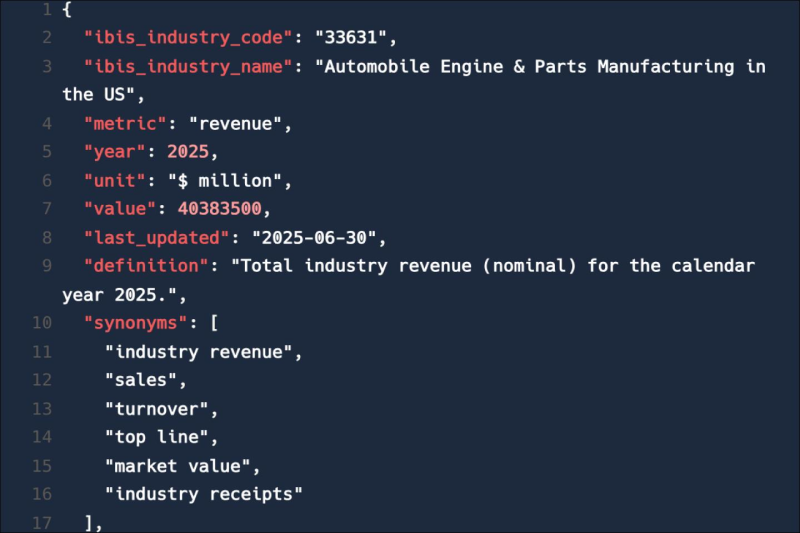
Feed trusted, human-driven industry intelligence straight into your platform.
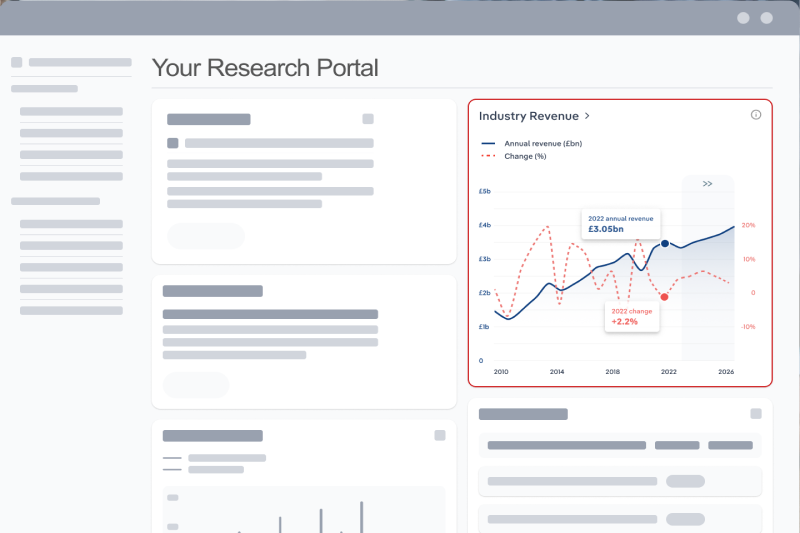
Streamline your workflow with IBISWorld’s intelligence built into your toolkit.
Explore industries with similar markets, supply chains, and economic drivers to gain broader context and insights.
When the stakes are high, you need intelligence that cuts through the noise—wherever you work.
The domestic tourist visitor nights in Australia in 2027 was 385.5 million.
The domestic tourist visitor nights in Australia grew by 3.45% in 2027.
IBISWorld’s data and analysis on domestic tourist visitor nights in Australia includes forecasted growth rates over the next five years.